
Introduction: making industrial vision truly operational
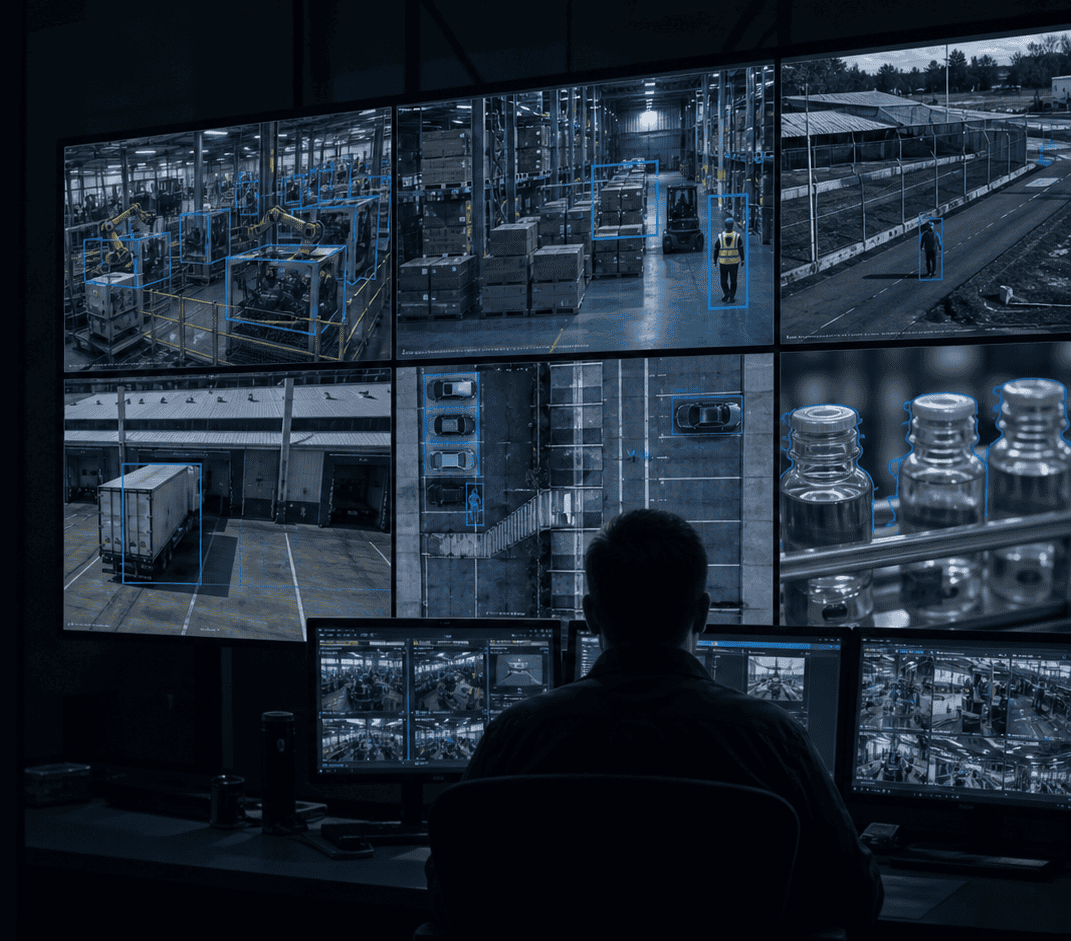
Industrial environments already generate a significant amount of visual data through security cameras, industrial sensors, drones and mobile equipment. The challenge is no longer just to obtain images: it is to be able to analyze them quickly and turn what is observed into actionable information.
Rapid ViZ addresses this challenge by combining edge processing, artificial intelligence and real-time supervision in a vision platform designed for autonomous inspection and surveillance. The platform can detect anomalies, perform targeted inspections, monitor multiple video sources and generate alerts directly from the field. [1]
An architecture designed for real time
In a cloud-first vision architecture, images generally need to be transmitted to a remote infrastructure before being analyzed. This approach can create dependency on connectivity, increase the amount of data transferred and complicate use cases that require a fast response.
Rapid ViZ favors an Edge AI architecture, where a significant part of the processing is performed directly near cameras and equipment. This approach helps reduce latency, limit the amount of data that must be transferred and maintain certain perception capabilities when connectivity is limited.
The NVIDIA Jetson platforms targeted for Rapid ViZ edge deployments are specifically designed for local execution of artificial intelligence and robotics applications. [2]
From surveillance to targeted inspection
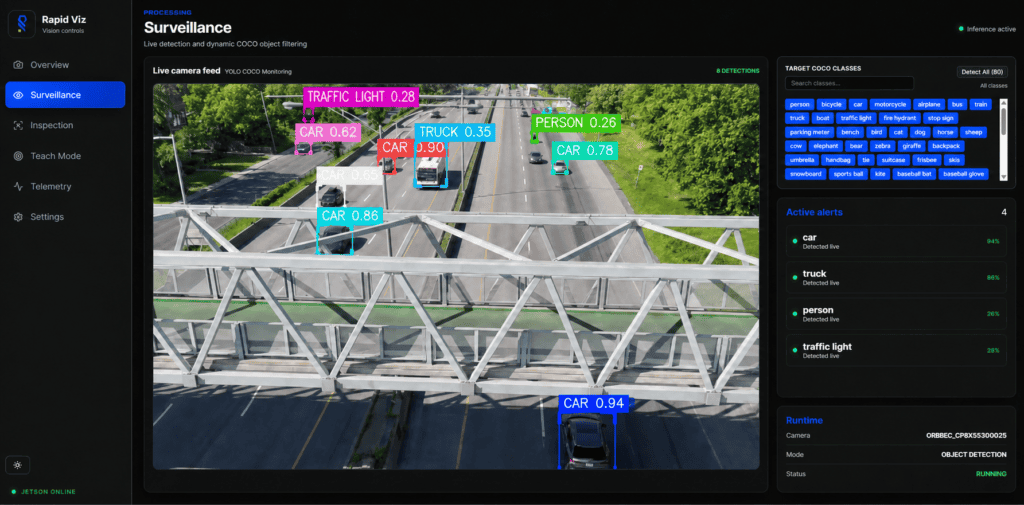
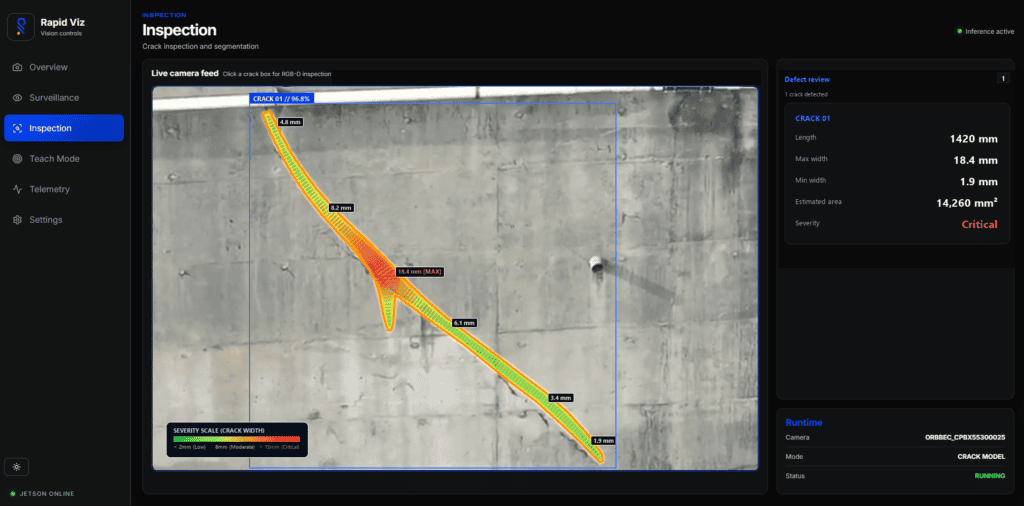
Rapid ViZ distinguishes between two complementary needs: continuous surveillance and targeted inspection.
Continuous surveillance makes it possible to observe video streams and automatically look for events or anomalies. A camera can therefore evolve from a mainly passive tool into a source of information capable of flagging a situation that requires intervention.
Targeted inspection makes it possible to perform a more precise analysis when an area, part or potential defect requires closer attention.
This combination helps maintain continuous perception of the environment while focusing more advanced processing on the elements that are truly relevant.
Teaching what needs to be monitored
One recurring challenge in industrial vision is the constant evolution of operational needs. A plant may introduce a new part, a new configuration or a new defect to monitor without wanting to rebuild its entire vision system.
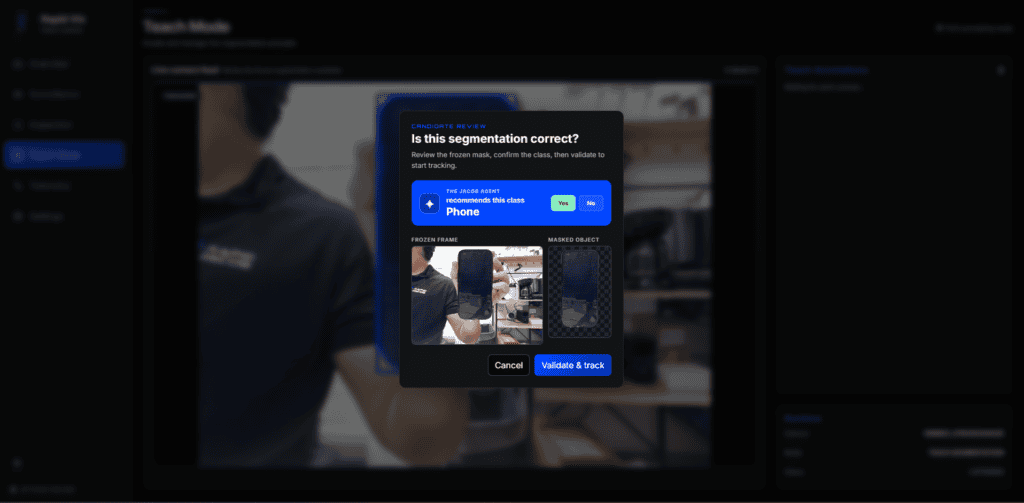
For this reason, Rapid ViZ includes a Teach mode that allows the user to interact directly with perception in order to identify the elements that matter for their application.
This approach brings field expertise closer to artificial intelligence capabilities: the operator defines what is relevant in their environment, while the platform provides the tools needed to integrate that information into surveillance and inspection functions.
A common layer for multiple video sources
Industrial facilities often use equipment from different manufacturers. Rapid ViZ is designed to integrate several types of video sources while providing a common software layer for operating them.
The use of standards and protocols such as RTSP and ONVIF helps integrate with existing IP video infrastructures. ONVIF aims to standardize interfaces between IP-based physical security products and is therefore an important element for video system interoperability. [3]
This approach makes it possible to leverage equipment already present on a site and reduce the need to systematically replace the capture infrastructure when adding new intelligent vision capabilities.
Supervision and telemetry
An autonomous system must also allow teams to understand its own operating state.
Rapid ViZ includes telemetry and supervision functions that make it possible to monitor the operation of perception systems and detected events.
This distinction is important in an industrial context: the absence of a detected anomaly does not necessarily mean that all system components are operating correctly. Supervision therefore makes it possible to monitor both the observed environment and the state of the capabilities used to monitor it.
Use cases
The same architecture can be adapted to several operational contexts:
- part inspection and defect detection in manufacturing;
- surveillance of critical equipment and areas;
- detection of health and safety situations;
- tracking of objects, vehicles or equipment;
- supervision of construction sites and infrastructure;
- site surveillance using fixed or mobile cameras.
The value of an industrial vision platform therefore does not depend only on the artificial intelligence model used. It also depends on how capture, perception, analysis, supervision and operational systems are integrated.
Conclusion
Industrial vision becomes truly useful when the results produced by artificial intelligence can be integrated directly into operations.
Rapid ViZ adopts this approach by bringing sensor processing closer to the field, combining continuous surveillance and targeted inspection, and allowing users to adapt perception more easily to real-world conditions.
The goal is to evolve the camera from a tool that simply makes it possible to see into an infrastructure capable of detecting, interpreting and reporting what matters for operations.
